01
Base load
Traditional plates establish the conventional external resistance.

Technology
PowerCurve integrates progressive elastic resistance into a strength-training platform and measures and displays the precise band load being applied.
Conventional accommodating resistance
Accommodating resistance changes the external load through a lift. In conventional setups, bands or chains attach directly to the barbell to add resistance as it rises.
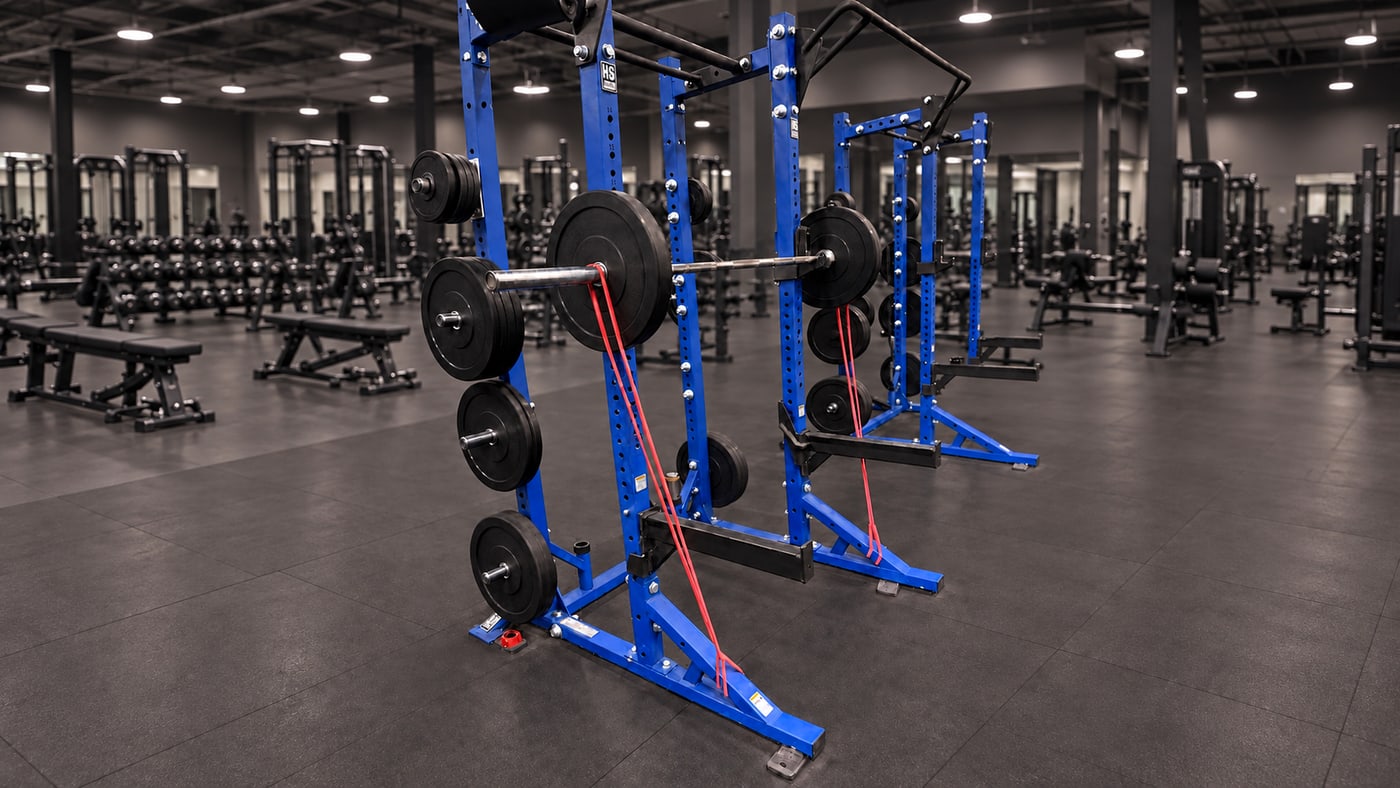
Bands anchored below the bar stretch as it rises. Band selection, starting length, and anchor position shape the added resistance.
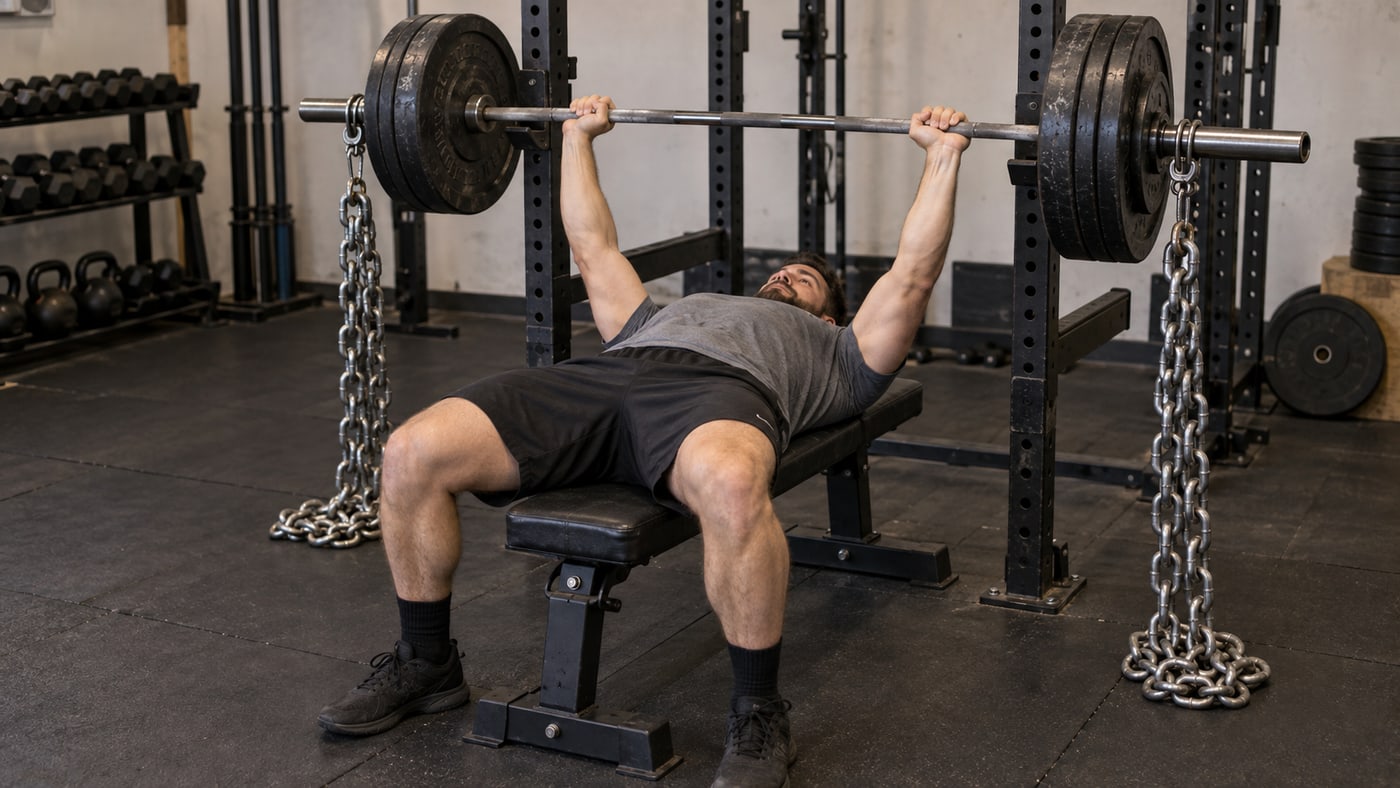
As the bar rises, it supports more of the chain's weight. Chain length and the amount resting on the floor determine how the load changes.
Coaches can measure and reproduce conventional setups, but must account for the attachment points, band stretch, or hanging chain length. Plate weight alone does not describe the total resistance throughout the lift.
Learn more about the methods: NSCA: elastic resistance · NASM: chain resistance.
The PowerCurve approach
PowerCurve integrates the elastic-resistance path and band-load displays into the equipment. The plate load and band contribution can be adjusted independently.
The training concept is familiar. The difference is the system integration:
All as an integral part of the equipment rather than an improvised add-on.
 Band-load path
Load model
The plate load establishes the base. As the bands stretch, their contribution increases. The result is a combined load that rises through the movement.
The visualization is conceptual—not a calibration chart or a claim that one resistance profile is optimal for every exercise.
Design principle
Keep the movement familiar. Make the variable resistance measurable, repeatable, and controllable.
System logic
Traditional plates establish the conventional external resistance.
Bands add a resistance component that increases as the movement progresses.
Integrated displays make the elastic contribution visible in real time.
Compare the setup
The training method stays familiar. PowerCurve changes how the variable-resistance component is applied, adjusted, and measured.
Programming flexibility
A coach can alter the relationship between fixed and elastic resistance while keeping the underlying movement familiar.
Plate and band contributions can be manipulated separately.
Band measurement enables deliberate and repeatable band loading.
See the system
Training guide
Compare bands, chains, and PowerCurve, learn what to record, and find answers to common setup questions.
Read the training guide